

Amateurs typically lack access to medical-grade tools like high-frequency machines, professional-strength hydrafacials, or dermaplaning instruments.
represents a growing movement of people who treat their hobbies and online presence with professional-level dedication. This "serious leisure" approach often blurs the lines between what we do for a living and what we do for fulfillment. The Work: From Hobbyist to "Pro-Am"
The short answer is . When executed correctly, amateur facials can deliver 80% of the benefits of a professional treatment for 10% of the cost. However, to understand how they work, we must dissect the anatomy of a facial, the tools Jan has in her kitchen and bathroom, and the biological science of skin regeneration.
The products and techniques used can vary widely, depending on the individual's preferences and skin type. jan amateur facials work
I can design a step-by-step amateur facial blueprint tailored directly to your needs. Share public link
Use a kaolin or bentonite clay mask on oily zones to draw out impurities.
Regular exfoliation ensures that your daily serums and moisturizers penetrate deeper and work better. 3. The Limits of Amateur Facials Amateurs typically lack access to medical-grade tools like
What specific items make amateur facials work? You do not need a spinning brush or a galvanic current device. You need these five items, all under $15:
A professional facial at a spa or dermatologist’s office can be a relaxing, rejuvenating experience, but regular treatments—which can cost anywhere from $75 to $250 per session—are out of reach for many people. The good news is that you don’t need to book a pricey appointment to give your skin the deep-cleanse and glow-boosting treatment it deserves. With the right steps and products, an at-home amateur facial can deliver remarkable results that rival those of a professional service.
At-home dermarolling tools often have poor-quality needles that bend, creating microscopic tears in the skin rather than clean punctures. This introduces bacteria deep into the dermis. How to Build a Safe, Effective At-Home Facial Routine The Work: From Hobbyist to "Pro-Am" The short answer is
An amateur facial refers to any complex, multi-step skincare treatment performed at home by someone without a professional esthetician or dermatological license. Unlike your daily cleanse-and-moisturize routine, these at-home sessions mimic spa experiences. They typically involve a combination of: Deep cleansing and steaming Exfoliation (chemical or physical) Targeted facial masks Facial massage or tools (like ice rollers or Gua Sha) Layered serums and heavy moisturizers
Achieving results at home requires following a specific sequence. Amateur facials work by systematically preparing, treating, and sealing the skin. 1. Thermal Skin Preparation
To write an honest article about how amateur facials work, we must address the failure points. When Jan’s facial fails, it is usually due to three errors:


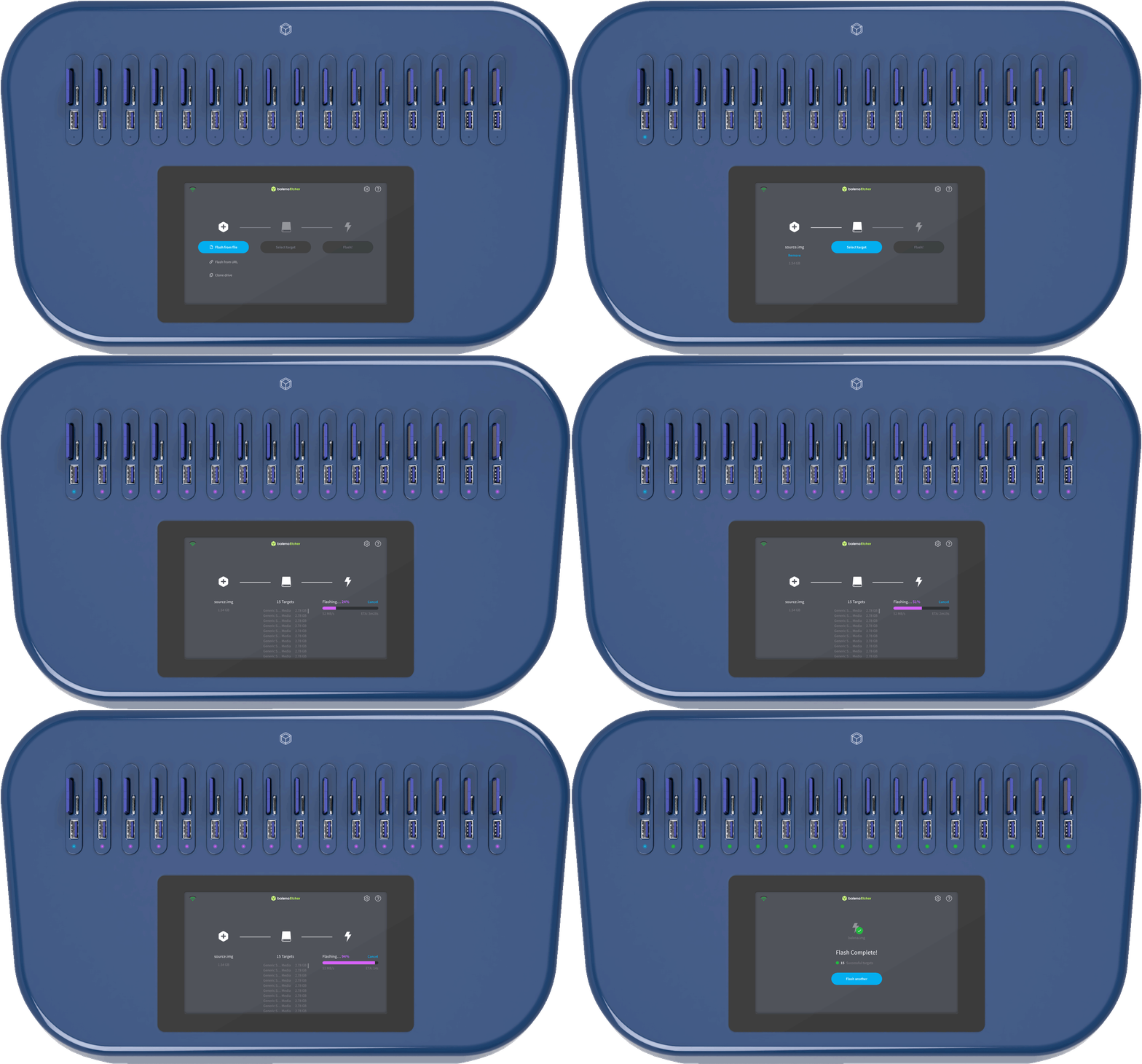
Every EtcherPro can flash up to 16 drives at a time if you are flashing from an online source. If you are flashing from a physical drive, you would be flashing up to 15 drives at a time, as the first slot would serve as the source. In the daisy-chaining scenario, you would only require one slot to serve as a source to flash the entire stack, when flashing from a physical drive.
EtcherPro offers USB (type A), SD and microSD interfaces by default, so you can flash up to 16 different drives / devices simultaneously. For instance, you can flash a balenaFin, a USB drive, an SD card and a microSD at the same time, as long as there is only one target per slot, and the source being flashed is the same for all target types.
EtcherPro supports USB (type A), SD and microSD interfaces, and can also flash single-board computers that are capable of being flashed via USB, as long as they are supported by Etcher. You can flash compute modules through carrier boards, for instance, flashing a Raspberry Pi CM3 through a balenaFin.
EtcherPro runs our open-source data-flashing software, Etcher, which can flash any kind of data. If you want to make sure that Etcher is capable of flashing your drive / device, you can download the latest version of Etcher and test it on your system to ensure compatibility.
When writing 16 drives simultaneously, EtcherPro can write up to 52 MB/s per drive, while when writing just 1 drive, EtcherPro can reach up to 200MB/s, so long as the drive / device can support those flashing speeds.
Etcher has a feature known as ‘trimming’ which can potentially accelerate the flashing of certain images by avoiding writing unused parts of ext partitions. As a result, you effectively get a bonus on the flashing speed.
EtcherPro flashes all target drives simultaneously, as such, the speed is determined by the drive that writes slowest. If you flash 1 drive that writes slowly, and 15 fast ones, the slow drive will determine the overall write speed. To account for this, make sure that all the drives, including the source drive (if any), can write at least as fast as EtcherPro flashes (52MB/s for 16 drives). Oftentimes, the advertised speed for a drive is the reading speed, rather than the writing speed (which is much slower). If you are sure your setup is up to spec and you still have issues please contact us.


.webp)